Home > News > Industry News
Container houses made from steel often use high strength materials such as ASTM A572 grade steel that can handle yield strengths between 50 to 65 ksi. What this means in practice is around 35 percent less weight than standard carbon steel options, yet they still keep their structural integrity intact. These lighter structures allow for bigger open spaces and multiple floors without needing so many support columns throughout the building. According to recent research from Ponemon in 2023, these steel frames can actually stand up against winds blowing at speeds reaching 130 miles per hour plus earthquakes with acceleration forces of 0.3g. That kind of durability makes them particularly good choices when constructing buildings in areas prone to natural disasters or extreme weather conditions.
Galvanized steel gets its protection from a layer of zinc on top of the actual metal, which helps resist corrosion pretty well in normal weather conditions. Most folks need to maintain it roughly every fifteen to twenty years though. Corten steel works differently by developing its own protective layer over time that actually heals itself when damaged. This makes it much better at standing up to atmospheric corrosion compared to regular carbon steel, especially near coasts where salt air is a problem. Tests show Corten performs about four to eight times better than standard options according to ISO standards for severe coastal exposure (Class C4). The lifespan stretches out to around twenty five to thirty years before needing attention. Although Corten comes with a higher price tag typically between 25% and 35% extra compared to galvanized steel's 12% to 18% markup, many builders still prefer galvanized materials for projects where money matters most and corrosion isn't going to be a big issue. Industry experts often point out how Corten pays off handsomely in the long run for structures located in those damp coastal regions where other materials would fail sooner.
Steel shows consistent behavior when stressed because of its elastic modulus around 29,000 ksi and thermal expansion ranging between 6.5 to 12.8 micro inches per inch per degree Fahrenheit. Even at extremely low temperatures like minus 40 degrees Fahrenheit, high strength steel keeps about 85 percent of its ability to bend without breaking which is way better than aluminum's roughly 52 percent. This means steel doesn't crack easily in freezing conditions. When things heat up to around 200 degrees Fahrenheit, the material only bends less than 0.15 inches over a ten foot length. All these characteristics make steel folding containers remarkably stable regardless of temperature fluctuations from as low as negative 58 degrees all the way up to 150 degrees Fahrenheit during normal operation.
Switching from Grade 36 to Grade 50 steel gives about a 20% boost in load capacity while letting manufacturers make walls thinner by roughly 1/8 inch which makes all the difference when building those foldable joints. But things get tricky with even higher grades like Grade 65 and above since these need very specific welding techniques to avoid problems with hydrogen cracking during fabrication. A recent report from Materials Performance in 2024 points out that Grade 50 actually works best for most applications because it balances strong tensile properties around 70 to 100 ksi with the practical aspects needed for making modular housing components without too many headaches during production.
In coastal and humid climates, salt spray accelerates steel corrosion by 5â10â compared to inland areas. Specialized protection is essential. A 2023 Marine Coating Guidelines study found that epoxy-polyurethane hybrid coatings reduce rust formation by 92% after five years of saltwater exposure, significantly extending service life in aggressive environments.
Multi-layer coating systems combining zinc-rich primers (50â80 µm) with UV-resistant topcoats outperform single-coat solutions. Polyurethane finishes maintain 98% adhesion after over 1,000 hours of humidity cycling, while epoxy layers inhibit microcrack propagation under structural stress, ensuring durable protection at stress points.
Hot-dip galvanization creates a zinc-iron alloy barrier that delivers 75â100 years of protection in mild climates. Powder coatings add 20â30% thicker, pore-free layers compared to liquid paints, enhancing durability. Scratch resistance varies by formulation, typically ranging from 3H to 7H pencil hardness, making them suitable for high-wear applications when properly specified.
Biannual inspections of welds and folding joints are crucial, as 78% of corrosion failures originate at untreated edges. Reapplying ISO 12944-certified coatings every 8â12 years ensures less than 5% surface degradation, even under pH 3â11 exposure conditions, preserving structural integrity over decades.
The ASTM A572 grade steel frames offer impressive yield strengths ranging from around 50 to 65 ksi, yet still maintain enough flexibility to handle seismic events effectively. Recent research published in 2021 by materials engineers indicates that when welding joints with HSLA steel instead of regular carbon steel in modular construction, these connections can actually handle roughly 18 to 23 percent more stress before failing. Practical fatigue tests have demonstrated minimal movement at the joints - less than half a millimeter displacement even after going through what's equivalent to about 200 hours of simulated road transportation. This means structures built with these materials won't deform or shift out of place when being moved between locations, which is crucial for many industrial applications where structural integrity must be maintained throughout transport.
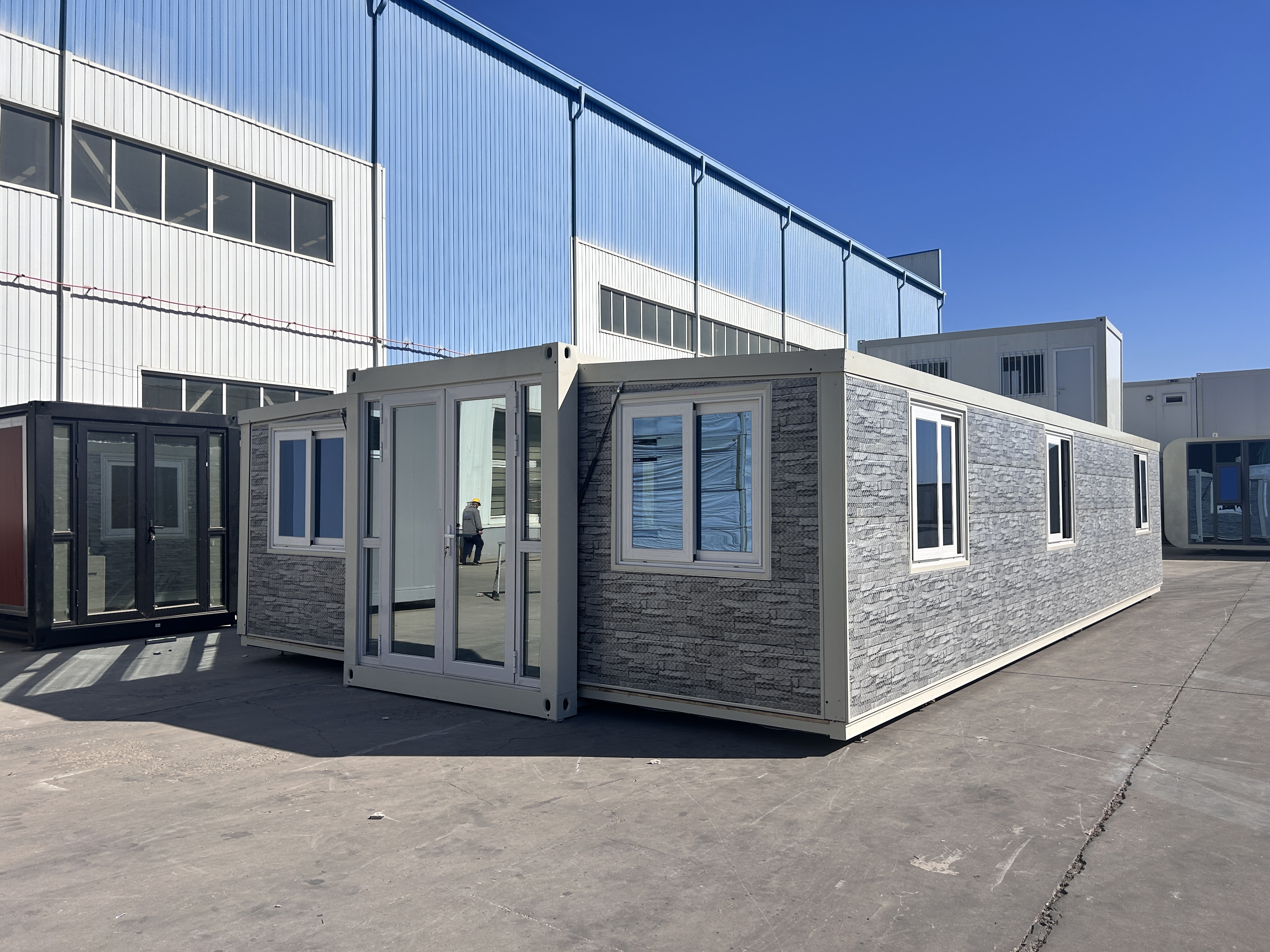
The hydraulic folding system incorporates dual axis pivots with 10mm steel reinforcement plates that spread the weight around better than traditional setups. According to research by Zhang and colleagues back in 2016, this design cuts down on point load stress by about a third. When tested through finite element modeling, these systems stay stable even when faced with snow loads reaching 3,200 kilograms per square meter, which is actually 40% higher than what most building codes require. What makes them really useful for large structures is their advanced load transfer technology. These systems can expand smoothly from 20 feet all the way up to 60 feet while still keeping that side-to-side rigidity intact, something many competitors struggle with.
Tests on the lifespan of these structures indicate that steel folding container houses built using cold-formed hollow sections maintain around 92% of their initial strength even after going through 500 deployment cycles. The hinge joints are made from S355J2+N weathering steel, a material choice that forms natural protective oxide layers over time. These layers help cut down on crack spread by roughly two thirds, according to lab results. After all those cycles, ultrasonic checks find minimal wear too – less than half a tenth of a percent thickness loss in parts that move the most. This kind of durability makes these containers suitable for repeated use across multiple projects without compromising structural integrity.
Steel folding container houses meet UL 580 wind uplift Class 90 certification, enduring sustained winds of 150 mph. Interlocking steel panel systems maintain cohesion under Category 4 hurricane conditions, verified by ISO 17025-accredited laboratories.
The high-strength framework resists wind pressures exceeding 40 psf (ASCE 7-22), with folded connections showing less than 2mm deflection during hurricane-force gust simulations. Aerodynamic roof angles reduce wind uplift forces by 30% compared to flat roofs, improving overall stability.
Roofs with a 6:12 pitch efficiently shed snow under loads up to 70 psf, surpassing IRC requirements for heavy snow zones. Triple-layer galvanized steel panels incorporate continuous thermal breaks to prevent ice damming, enhancing performance in freezing conditions.
Controlled expansion joints accommodate daily temperature swings of up to 120°F, limiting structural movement to under 5mm across 40ft units. Powder-coated surfaces reflect 85% of solar radiation, minimizing heat absorption and preserving dimensional stability in desert climates.
A 12-unit container housing development in Miami survived Hurricane Ian (2022) with 145 mph winds, suffering no structural deformation. Post-event inspections recorded a fastener failure rate of less than 0.1% across 2,800 connection points, demonstrating real-world resilience.
Base-isolated steel containers reduce seismic energy transfer by 58% compared to fixed-base units, according to a 2023 durability simulation study. Moment-resisting frames comply with IBC seismic design Category E, achieving 0.5% inter-story drift limits.
Grade 50 steel components exhibit 18% elongation before failure, absorbing three times more seismic energy than rigid concrete systems. Modular connections allow up to 15° of rotational movement without compromising structural integrity, enhancing survivability during earthquakes.
Friction pendulum isolators reduce peak floor accelerations by 65% in high-seismic regions (ASCE 7-16). Helical pile foundations installed at 30° angles achieve 25,000 lb uplift resistance, providing secure anchoring on sloped or unstable terrain.
 EN
EN